
A Broader Ambition Needs a Hard Starting Point
General Liquidity is not being built to become a narrow trading app. The longer arc is a broader financial operating layer: software that helps people move from passive economic participation to actual economic agency. But that ambition still needs a first surface, and the first surface cannot be chosen by branding logic alone. It has to be chosen by where the system can prove the most important things fastest.
That is why trading comes first. Not because trading is the whole future, and not because every user should be turned into a trader, but because trading is one of the clearest places where signals, judgment, execution, and consequences meet in real time. If you are trying to build systems that let humans delegate meaningful financial work to software, there is no cleaner proving ground. The strongest financial-trading agents are now judged on realized performance in live multi-market arenas rather than verbal fluency.
Easier wedges exist. Softer categories exist. But they hide whether the system is actually good. Markets do not.
Markets Are Already Machine-Native Enough to Matter
One reason trading is such a strong first wedge is that financial markets are already far more legible to software than most of the economy. Prices update continuously. Venue state is observable. Order books, flows, volatility, funding, spreads, and execution outcomes can all be queried, monitored, and fed into a system loop. In crypto this is even more obvious because the stack is open, programmable, and globally accessible by default. In stocks the stack is more constrained, but it is still structured enough to support serious operator workflows. Retail-access trading APIs already expose enough live market state for software to operate meaningfully.
That matters because delegated financial action needs a domain where software can actually see the environment it is operating in. Many parts of personal finance are important but still relatively opaque, slow, and workflow-heavy. Markets are not frictionless, but they are information-dense and feedback-rich. They expose enough surface area for a control layer to do real work rather than just provide narrative comfort around a human process.
The contrast with the rest of software is concrete, not rhetorical. Crypto venues never close: they stream quotes and full order books continuously, every hour of every day, roughly eight thousand seven hundred hours a year. US equities, even behind session hours and data entitlements, still expose a structured, queryable view of price, size, and fills for about sixteen hundred hours a year, six and a half hours across roughly two hundred fifty trading days. Most other domains a software agent might enter, from support to scheduling to internal ops, have no equivalent ground truth arriving on a tick at all.
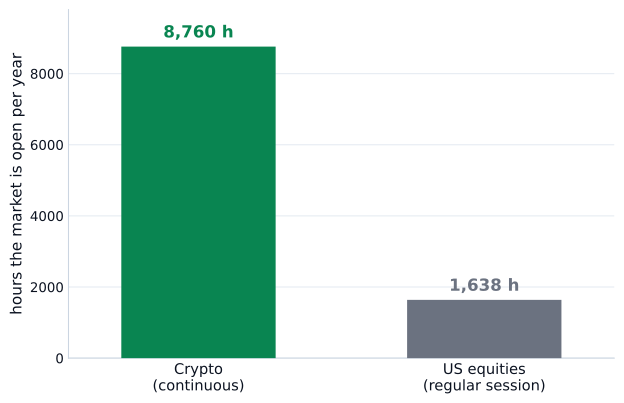
If the future of finance is more programmable, then trading is where that programmability is already operational, not hypothetical.
Trading Compresses the Feedback Loop
The second reason trading comes first is that it compresses truth. In many software categories, systems can sound plausible for a long time before reality catches up. The interface can look polished, the model can sound smart, and the workflow can feel helpful while the underlying system is still weak. Markets are much less forgiving. The loop from signal to decision to action to outcome is shorter, more explicit, and much harder to fake. Adversarial-market benchmarks show LLM trading agents fall back on fixed strategies and lack genuine responsiveness even when the model sounds coherent.
This is exactly what you want if you are building agentic financial software seriously. You need a domain where the system cannot hide behind presentation. It has to interpret context, handle uncertainty, track changing state, preserve memory, route across tools and venues, and make the user legibly better at acting. If it fails, the failure shows up. If it helps, that help is visible too. Current trading research is already centered on sequence modeling, order-book context, and short-horizon signal extraction. Recent work on LLM trading agents pushes this further: reported, in-sample alpha routinely fails to survive into live deployment.
A hard feedback loop is not a drawback here. It is the whole advantage. It forces the product to become real earlier.
Delegation Is the Real Product
Another reason to start with trading is that it clarifies what Gordon is actually building. The core problem is not chat about markets. The core problem is delegation under constraints. A user needs to express intent, inspect reasoning, manage uncertainty, review plans, approve execution, and maintain control while software does more of the work. That product shape becomes obvious in markets because the stakes are concrete and the need for discipline is immediate.
In a weaker category, the system can get away with being a polished assistant. In trading, that is not enough. The product has to become a real operating surface: memory, watchlists, execution context, approvals, logs, replay, and workflows that survive across sessions rather than resetting every time the model speaks. That is why a terminal-first Gordon makes sense. The terminal is not cosmetic. It is a natural surface for serious operators who want speed, control, and a system they can actually steer. Multi-agent trading systems are moving toward explicit, role-based workflow decomposition rather than one-shot delegation.
Trading exposes the gap between “AI that sounds useful” and “software you can actually delegate money-related work to.” Closing that gap is the real product.
Why Crypto and Stocks, Not Everything at Once
Starting with crypto and stocks is not a compromise. It is the right scope. Crypto gives us the most machine-native, globally programmable financial environment available today. Stocks give us the most culturally and economically legible public-market environment for a much wider user base. Together they cover both the frontier and the mainstream of modern market participation. Foundation models for markets are now pretrained on billions of trade events across assets and regions, which reinforces the value of cross-asset systems rather than single-venue toys.
That combination matters. If Gordon only operated in crypto, it could be dismissed as a product for a niche market structure. If it only operated in stocks, it would miss the part of finance where programmability is advancing fastest. Modern forecasting models emphasize probabilistic reasoning rather than fake certainty. Together they create a stronger training ground for the orchestration layer itself. It forces the system to deal with multiple venues, trust models, data shapes, execution styles, and user expectations from the beginning.
It also keeps the product honest. We do not need to claim to cover every financial job on day one. We need to cover the first ones well enough that users feel a real increase in agency.
Earning the Right to Expand
The broader vision does not disappear because trading comes first. It becomes more credible. If we can build a system that helps users delegate market analysis, planning, and execution with real trust in crypto and stocks, then we are earning the right to move outward into adjacent financial workflows. Research, portfolio management, treasury, prediction markets, broader neo-finance surfaces, and eventually more general economic agency all sit downstream of the same core problem: turning intent into controlled action across fragmented systems.
That is why trading is the beginning, not the boundary. It is where the abstractions get stress-tested first. It is where the control layer either proves itself or gets exposed. And it is where the future financial operating system can start as something concrete enough to matter.
If you want to build software that increases economic agency, the right first question is not “where can we tell the best story?” It is “where do we have to become real the fastest?” For us, that answer is trading.